by Maria-Raluca Ențuc
Ultranationalist TikTok star Călin Georgescu unexpectedly won the first round in Romania’s presidential election. The Constitutional Court annulled the presidential election, citing declassified Romanian intelligence documents of severe foreign interference. Amid intense internal conflicts, this incident has drawn sharper attention to how external actors and the digital sphere can destabilize a democracy.
On Sunday 24th of November 2024, Călin Georgescu surprised the entire Romanian population, by leading the race to become the next president. Why is this a shock? He had a 2% initial support in the opinion polls, was absent from any mainstream TV debates, and did not have any political party. On top of that, many citizens learned about his name on that exact Sunday. The fact that he unexpectedly grew from 2% to 22% overnight and overturned the main candidates immediately raised questions among the public.
A quick scan of the current political scenario shows that Calin Georgescu is dubbed as “a Russia-supporting vaccine skeptic who praises his country’s WWII fascist leaders” and “a far-right EU and NATO skeptic”. He negates the existence of a war in Ukraine and believes that Romania would have more to gain if it maintained better relations with China and Russia. Further, he decided to promote a wide range of conspiracy theories and used religion as a core factor in his campaign, stating that “We are in God’s hands.”
So the question is: how did he get so many supporters?
There are two main factors that should be kept in mind: an unregulated TikTok campaign and the public’s rage about the status quo.
While declaring that he had no campaign expenses, his videos managed to become viral on TikTok. It involved a two-pronged strategy: including accounts with bot-like behavior that promotes the campaign without properly labelling it as political and taking advantage of the platform’s untransparent algorithm. According to The Guardian and Libertatea, some claims suggest the existence of evidence regarding the manipulation of the electoral process. Such activity resulted in raising fears of manipulation of public opinion and a lack of responsibility in TikTok’s approach towards political content, to alleged external interference and even possible cyber attacks. This immediately drew the attention of the European Commission and the national telecoms regulator ANCOM to investigate whether the social media platform complied with the EU’s Digital Services Act (DSA) requirements. Although TikTok has disagreed with these offenses, there are claims of political content highlighting Calin Georgescu being shared even on voting day.
Regarding the content, which was extensively and artificially promoted on TikTok as well as other platforms, it shows messages with populist tendencies, followed by dramatic music and subtitles. During the campaign, images and videos of Georgescu materialized as he was running in a competition, doing martial arts, and riding a white horse in a traditional Romanian shirt, similar to the viral edited photo of Putin riding a bear. Substantially, he uses the fear of the current state of affairs and finds answers in “Russian wisdoms.”
Also since Sunday, a couple of memes emerged to show the similarity between Calin Georgescu and Putin.
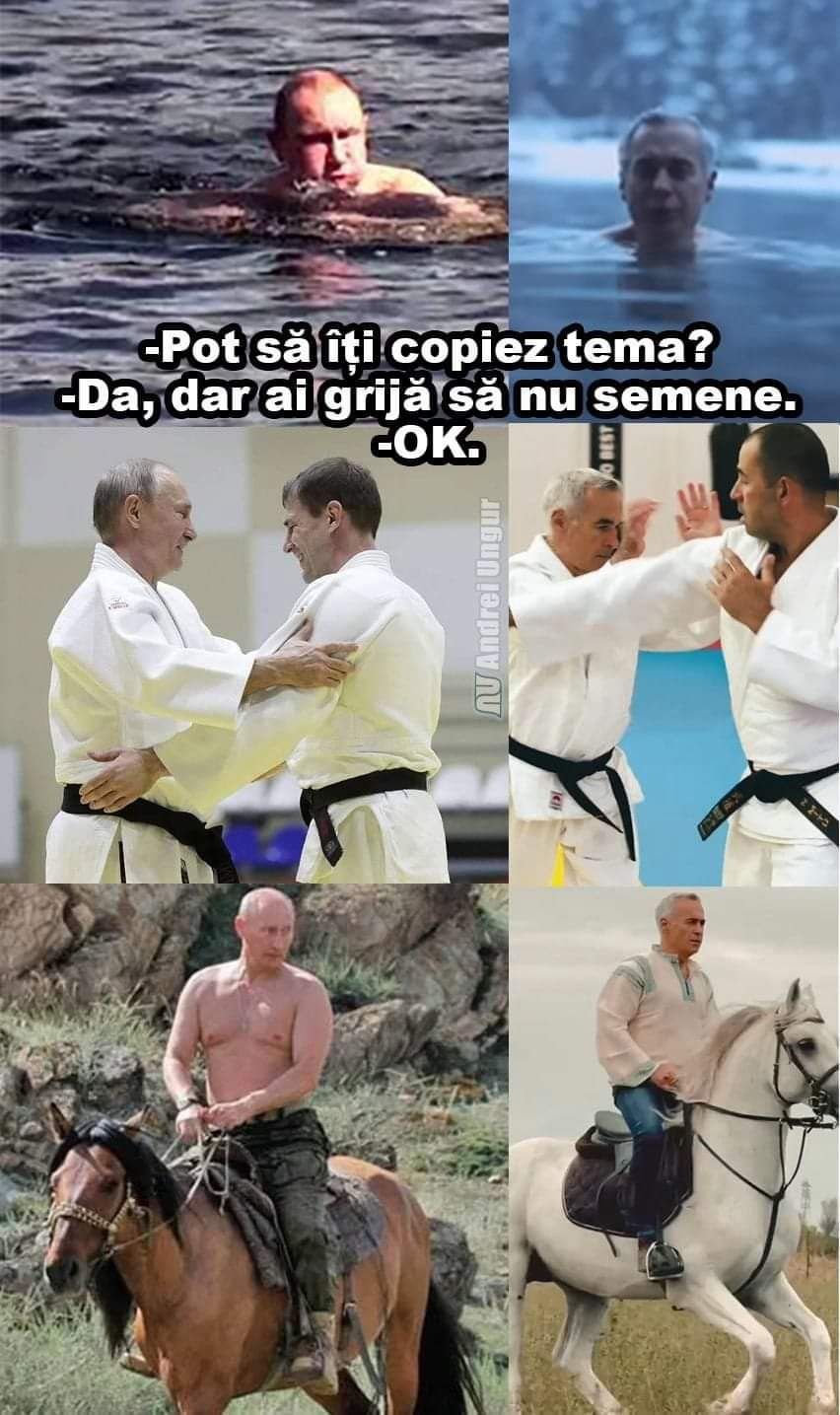
“- Can I copy your homework?
– Yes, but be sure to not look the same.
– Okay.”
source: Curentul
According to Marius Ghincea, a political scientist, the surge in support was driven by voters’ frustration with the two main parties, diminished trust in the establishment, and the reassuring message to make Romania more self-sufficient. Therefore, it could also be seen as a form of protest from the citizens’ side, by blaming the state for not managing the country better. In related political elections both Worldwide and across Europe, this has been seen to be an emerging trend. However, it can not be overseen the amount of power the social media app has had in such a limited time.
As Valérie Hayer, head of Renew Europe, has stated “We are witnessing an attack on democracy right before our eyes,” this brings questions as to whether TikTok should be immediately banned or not, especially in these fragile moments.
Romania’s political landscape has been thrown into chaos following the Constitutional Court’s decision to annul the first round of the presidential election. After declassified intelligence revealed severe hybrid attacks done by Russia, the annulment has delayed the presidential runoff, which were originally scheduled for December 8. This has resulted in the extension of the current president’s term. According to Romanian Intelligence Services (SRI), Georgescu’s campaign resembled Kremlin-led influence operations seen in Ukraine and Republic of Moldova. It should be noted that evidence suggests an indirect link between Russia and the Romanian elections. Declassified intelligence revealed that Georgescu’s campaign had benefited from illegal foreign financial support and promotional activities during banned periods. Meanwhile, criminal investigators have opened inquiries into the cyberattacks on election infrastructure, voter corruption, computer system fraud, and campaign money laundering involving at least €1 million, which contradicts Georgescu’s spending claims.
Furthermore, Tiktok, which has been suspected of influencing the election, faces investigations both in Romania and at the EU level. The European Parliament summoned TikTok representatives to explain their content moderation practices during the campaign, while the Commission also ordered the platform to preserve data related to the Romanian election. It has been revealed that TikTok has shut down three campaigns tied to the first round of voting, one of them being linked to a Kremlin-led media outlet, Sputnik. This questions the impact of such platforms on elections and echoes earlier warnings from SRI, which called for banning the app from 2022 due to spyware concerns.
This situation highlights the vulnerabilities of Romania’s political system, particularly its exposure to foreign interference and the influence of digital platforms. While TikTok’s role is still under investigation, its involvement reflects a growing trend of social media platforms interfering in democratic processes. The annulment has also raised questions about the credibility of Romania’s democratic institutions. For example, some parties are calling on the Constitutional Court to also nullify the parliamentary elections, held between the two rounds of the presidential contest, citing the same hybrid attacks that led to the presidential annulment.
The court’s ruling has left the electoral process in limbo. The delay in the presidential runoff, combined with investigations into cyberattacks and campaign irregularities, has left voters questioning the integrity of the process.
Social media platforms like TikTok have become tools for political interference, raising questions about regulation and accountability. Either way, it is not the first time platforms have meddled in the political affairs of one’s country and its democracy. Romania’s struggles also reflect global trends. The rise of far-right movements and the exploitation of digital spaces threaten democracies worldwide. It remains to be seen if the upcoming elections will reflect whether the country can overcome these challenges or remain vulnerable to external and internal influence.
Image source: Pixabay (header)
 The Euroculturer