
Although it was analysed that a substantial percentage of Europeans (90%) find it “unacceptable” for a wage imbalance to remain between men and women, the pay gap between the sexes approached 13% in 2021. This percentage only decreased by 4% as compared to the last ten years.
Across European Union (EU) member states, that pay gap had significant differences with regards to its percentage distribution. In 2022, it varied by 22% points, the lowest being -0.7% (Luxembourg) and the highest being 21.3% (Estonia). This sex-based discrimination is a challenge that the European Union has been attempting to address for years, such as by encouraging EU member states to implement relevant policies and legislation on a local level. Moreover, the EU has also undertaken analogous legislative action upon itself. Indeed, fundamental laws emphasise the importance of a lack of sex-based discrimination, including article 157 of the Treaty on the Functioning of the European Union or TFEU, enshrining the principle of equal pay for men and women. Another policy worth noting is Article 19, which aims to combat all forms of discrimination, including those based on sex. Moreover, since the implementation of other relatively “old” directives with regards to sex equality – including the one of the 19th of December 1978 regarding the principle of equal treatment for men and women in matters of social security (Council Directive 79/7/EEC) – newer directives have also been approved. This includes the 2000/78/CE Framework Equal Treatment Directive and the 2006/54/CE Sex Discrimination Directive, arguably some of the most fundamental directives on this subject.
It is also worth mentioning the recent EU Pay Transparency Directive which was adopted by the European Parliament on the 30th of March 2023. It consists in binding measures in order to increase transparency with regards to salary, meaning that employers will be prohibited from inquiring about a candidate’s pay history and will be required to disclose the salary ranges of employees – specifically regarding the sexist pay gaps (for companies with more than 100 workers). Moreover, companies with a sex pay gap greater than 5% will have to collaborate with employee’s representatives in order to conduct a pay assessment.
In addition to these policies, it is also interesting to mention that case law is also accumulating with regards to sex equality in the European Union; one of the oldest is the Defrenne II judgment of 8 April 1976 (Case 43/75). There, the CJEU ruled that sex-equal pay must extend to all agreements which are intended to collectively regulate paid labour, thus extending that the principle mustn’t be limited to the action of public authorities.
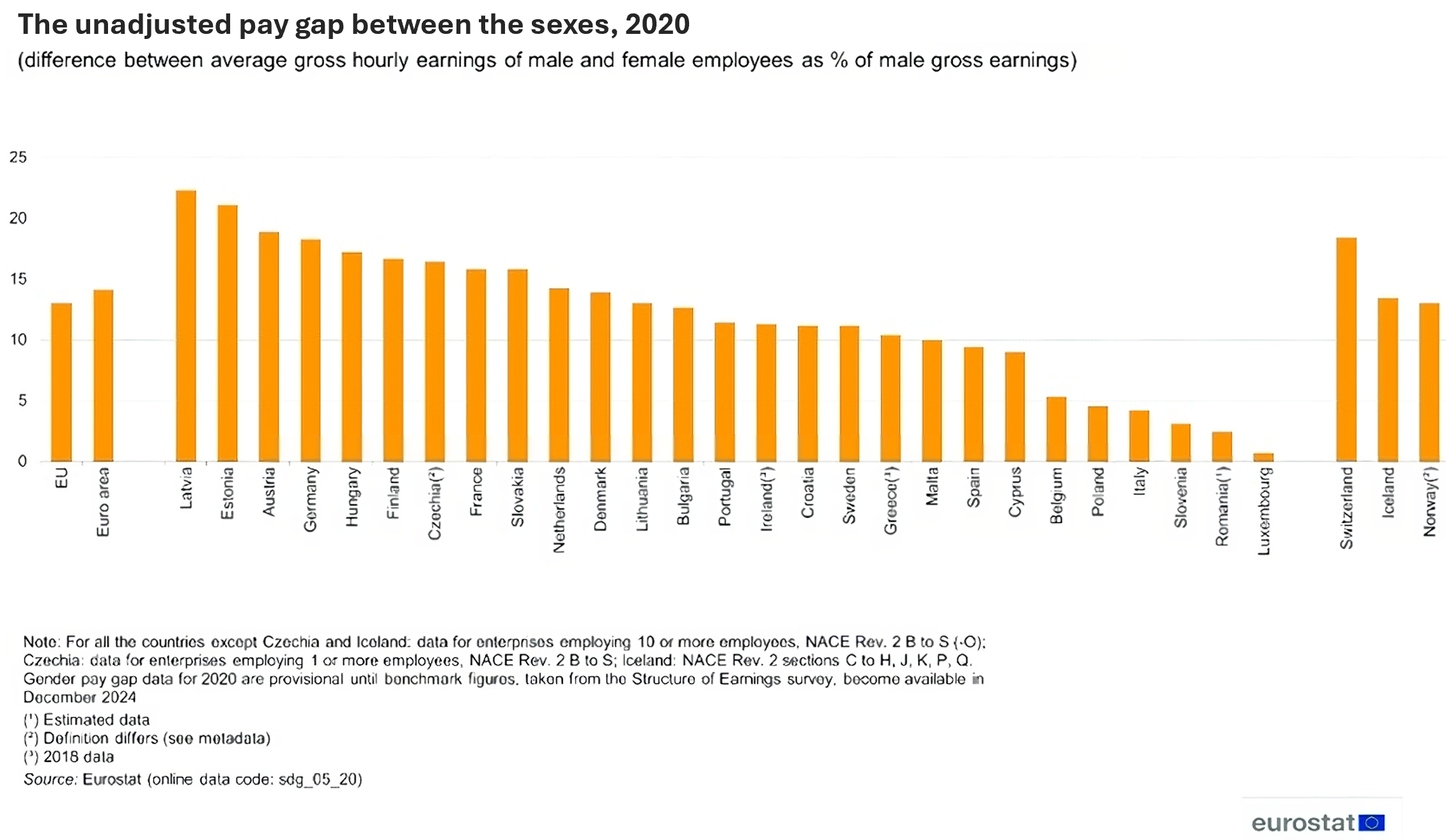
Although these policies are a positive legal advancement, the overall endeavour for sex equality still remains challenging because it entails overcoming drivers that are deeply entrenched within our societies such as unconscious bias and stereotyping. Moreover, it is interesting to note that these progressive actions aren’t only meant to further a sociological equal rights agenda; indeed, a large part of the reasons why these policies were generated stem from financial interests, analyses having demonstrated that salary-related sex equality strengthens the economy as a whole. Though, no matter the reasonings behind these actions, the positive impacts still stand. The EU has thus undertaken significant advancement with regards to social policies throughout the years, becoming an example for many countries and institutions.
Sources
Consolidated version of the Treaty on the Functioning of the European Union – PART THREE: UNION POLICIES AND INTERNAL ACTIONS – TITLE X: SOCIAL POLICY – Article 157 (ex Article 141 TEC) (2008). https://eur-lex.europa.eu/legal-content/EN/TXT/?uri=CELEX:12008E157
Council Directive 79/7/EEC of 19 December 1978 on the progressive implementation of the principle of equal treatment for men and women in matters of social security (1979) https://eur-lex.europa.eu/legal-content/EN/TXT/?uri=celex%3A31979L0007
Gender pay gap: Parliament adopts new rules on binding pay-transparency measures | News | European Parliament. (n.d.). https://www.europarl.europa.eu/news/en/press-room/20230327IPR78545/gender-pay-gap-parliament-adopts-new-rules-on-binding-pay-transparency-measures
Miller, K., Carlson, L., & Lahuerta, S. B. (2023). Gender pay gap: how new EU pay transparency laws will make men and women’s wages more equal. The Conversation. https://theconversation.com/gender-pay-gap-how-new-eu-pay-transparency-laws-will-make-men-and-womens-wages-more-equal-203257
Publications Office of the European Union. (2010). Compilation of caselaw on the equality of treatment between women and men and on non-discrimination in the European Union. Publications Office of the EU. https://op.europa.eu/en/publication-detail/-/publication/e8711e0f-767c-466e-9fae-325dd6d2544f
Social security — equal treatment for men and women | EUR-Lex. (n.d.). https://eur-lex.europa.eu/EN/legal-content/summary/social-security-equal-treatment-for-men-and-women.html
.————————————————————-.—————————————————————.—————————————————————.—————————————————————.—————————————————————.—————————————————————.—————————————————————.—————————————————————.—————————————————————.————————————————————-.———————————————————-.—————————————————————-.———————————————————-.————————————————————–.————————————————————.
 The Euroculturer
Very interesting, thank you for these insights.