
by Gian Paulo Paglinawan
When I applied for the EMJMD in Euroculture for the 2022–2024 intake, I looked up some Euroculture alumni from the Philippines on the Internet and social media. I thought it would be a great idea to know about them, learn from their experiences, and ask for practical details concerning the logistics of moving to Europe for the first time. As of this writing, I have found four alumni on LinkedIn: one from each cohort from 2018 to 2022. During my first semester in Groningen, Mr. Jelmer Herms, the course and consortium manager of Euroculture, and Dr. Prof. Margriet van der Waal, one of the professors at the University of Groningen, mentioned that two Filipinas would graduate in 2022. Not only did they spend wonderful semesters in Groningen, but they also completed the EMJMD with flying colors! What an excellent accomplishment that will inspire other Filipinos and young scholars to study Euroculture.
Introducing the Personal Background of the Filipino Alumnae
Patricia Miraflores, or Trixie, is from Quezon City, Metro Manila, Philippines. She initially studied industrial engineering at the University of the Philippines (UP) Diliman for two and a half years. Trixie moved to San Francisco, California, USA, in 2015 and obtained her double degree in social sciences and history at Minerva University. During her undergraduate years, she studied and lived in different countries, such as Hong Kong, the United States, and South Korea.
Alessandra Pantanosas, also known as Sandi, is from the Province of Rizal and earned her bachelor’s degree in European Studies at the Ateneo de Manila University (ADMU), focusing on international relations and French language and culture. She spent a summer term abroad in Strasbourg, France, which encouraged her to return there someday (She did!) for her graduate studies.

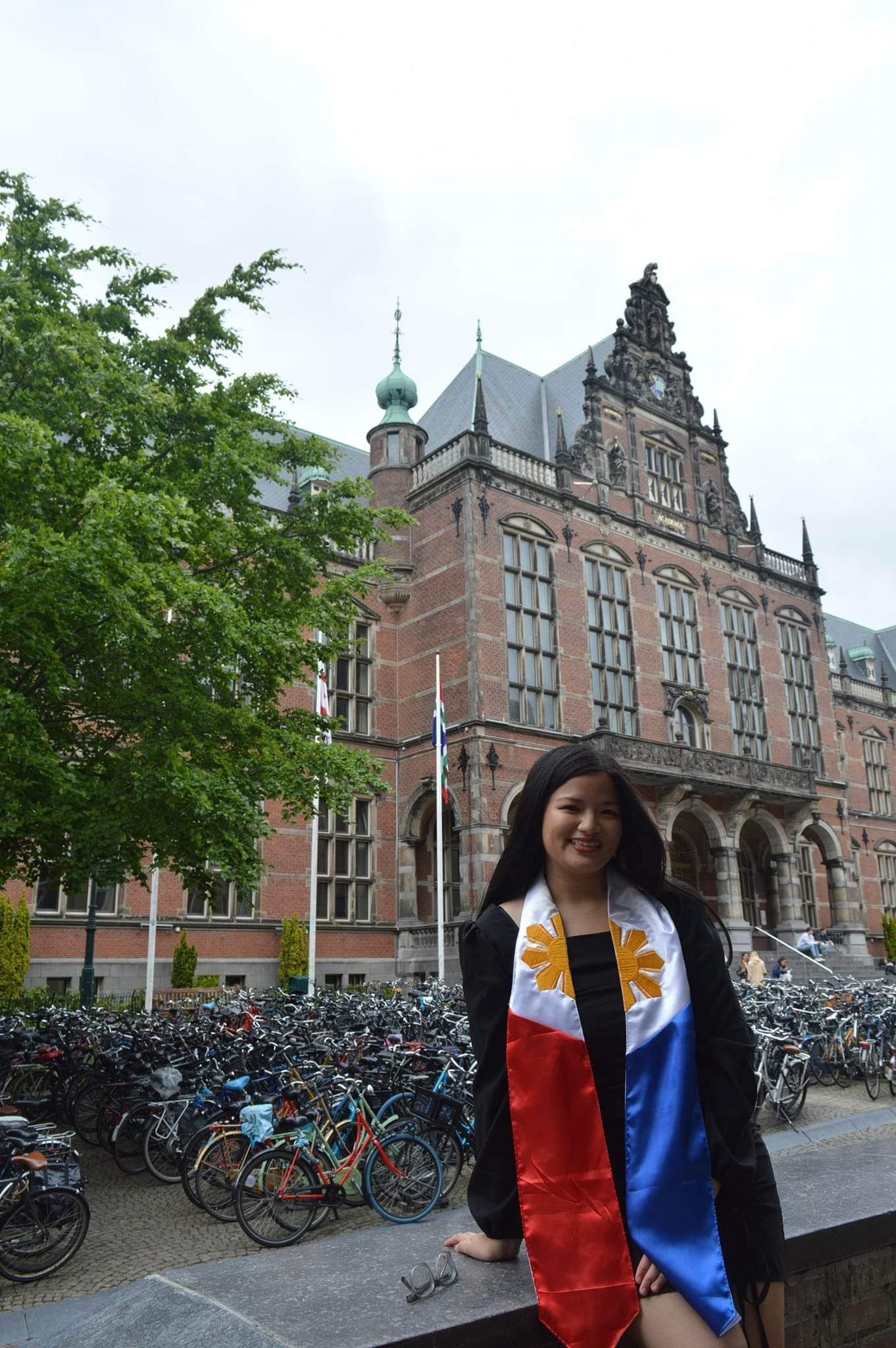
Their Motivation to apply for Euroculture
To start, I was interested to know what their motivation was in applying for the Euroculture Master. Because of their prior international academic experience, Trixie and Sandi expressed interest in the mobility aspect offered by the program. For Trixie, Euroculture “perfectly builds on my cross-cultural undergraduate experience.” And when looking for a postgraduate program that could help her acquire new skills and gain specialized knowledge in international affairs, Sandi “found that Euroculture ticked all these boxes.”
“Who wouldn’t want to work towards their personal and professional goal while traveling?” ~ Sandi Pantanosas
Advantages of studying Euroculture for Non-EU Students
I also asked them about the advantages of studying Euroculture for aspiring students from outside the EU.
Gee (interviewer): How can studying Euroculture benefit non-EU scholars in their future careers?
Trixie: For those in the academic/Ph.D. track like me, Euroculture’s interdisciplinary approach is amazing if you want to pursue a topic that involves the EU and the outside. The curriculum is broad enough to expand your understanding of the key concepts and develop strong critical thinking and analytical skills. At the same time, the last two semesters enable you to discover your academic specialization. In terms of professional experience, Euroculture gave me an edge in my current job for similar reasons. The project management skills I developed from this master’s program proved to be very transferable. At the same time, I am using the specialized knowledge I acquired from Euroculture – specifically on the topic of migration of third-country migrants. The core knowledge I developed from Euroculture is instrumental in my current job as an international education consultant for mostly non-EU individuals who want to pursue higher education in the EU and the UK.
Sandi: Non-EU students can visit several European countries because of the mobility aspect of the program. This gives them a chance to broaden their horizons, build an international network, and possibly find work opportunities. Employers typically value study abroad experiences, so this can help kickstart their careers. Euroculture also pushes students to be open-minded and immersed in the culture for personal and professional development. Through exposure to a foreign environment, non-EU students gain valuable life skills, independence, and self-sufficiency. Hence, they can demonstrate adaptability, resourcefulness, and intercultural competence through their Euroculture experience.
Asian Representation in Euroculture
Thus far, Sandi and Trixie are among the very few Euroculture alumni from the Philippines for the last ten years that I have been able to reach out to. As a Filipino myself, I asked them how important is Asian or Filipino representation in Euroculture and what unique perspectives Filipinos can bring to Euroculture.
Gee: How important is Asian representation in the Euroculture Master’s Programme for you?
Trixie: Great question! As a non-European graduate of Euroculture, I had to contend with this question several times during my Euroculture journey. Looking back, I can give two reasons why Asian representation is valuable to the Euroculture program.
First, Asian students represent the many ways we could think about European identity and integration from an outsider’s perspective. In my case, I was drawn to Euroculture because I spent my undergraduate years in five countries, including Germany during the height of the refugee crisis. After moving around so much, I became interested in these countries’ national narratives regarding belonging and foreignness in the context of migration. I joined Euroculture because I wanted to explore these concepts further in terms of non-European persons’ mobilities in and within Europe. Asian students could enrich the discussions and research at Euroculture by bringing these marginal lenses into focus.
Second, I believe that understanding European identity and integration also means interrogating the construction of who or what “belongs” to Europe. During my first semester at Groningen, we discussed the concept of Orientalism and how the Other remains instrumental to Europe’s self-affirmation and identity-building. Personally, I think there is a lot to unpack regarding the inherent Eurocentrism of academia and scholarship. From my experience, students from Asian backgrounds are in a good position to take such discussions to a higher level.
Sandi: Asian representation enriches the program with various backgrounds, experiences, skill sets, and knowledge areas. The name of the program itself – Euroculture: Society, Politics, and Culture in a Global Context – calls for a diverse and international group. Our lessons on Europe and its challenges aren’t limited to Europe. Similar issues – past, present, and future – can be seen worldwide. Thus, even if one is not European, one can think strategically about the issues and offer outsider perspectives. Europe may be the context and framework of the program, but it’s up to us to pick up the tools we gain from it and make a lasting impact not only in Europe but in Asia and every other continent and region.
Gee: What unique perspectives can a Filipino scholar bring to Euroculture?
Trixie: There are many ways to answer this question, so I’ll start with what I know best! As one of the largest diasporas in the world, Filipinos offer a unique perspective on the debates surrounding the autonomy of migration in Europe. As a Filipino scholar, I wanted to dig deeper into the case study of Filipino essential workers in the post-Brexit UK who currently have irregular status. This is what I explored for my Euroculture master’s thesis. On the one hand, Filipinos are globally acknowledged for their contributions as essential workers. At the same time, they’ve been subject to exclusions and exploitation in countries like the UK, where there is pretty strong anti-immigrant rhetoric. Here, I realized that Filipino workers in Europe – especially those with irregular status and who are in the care industry – offer new angles to Brexit and other key developments in European migration.
Apart from migration, I know Filipino Euroculturers who joined this program to explore Spanish-Filipino ties in the context of the Philippines as a former Spanish colony. Generally, students from countries that were former European colonies offer much-needed perspectives on Europe, not only the colonial past but also the present dynamics of neocolonialism.
Sandi: Philippine society is quite different from European societies. Everything from our government and education systems to our culture and values is different. In a school setting, the contents of our world history textbooks or how we learned to write research papers, for example, are likely different from our European peers’ textbooks and their research classes. This means Filipinos have many fresh perspectives and techniques to share, but we also have a lot to learn.
Professional or Research Track?
One of the features of Euroculture, apart from its interdisciplinary course offerings, is the opportunity for students to tailor the program to their interests and prepare themselves for a research-oriented track or an internship during the third semester. Due to the COVID pandemic, they accomplished their third semester remotely. Trixie interned at the Global Research Forum on Diaspora and Transnationalism based in New Delhi; Sandi completed her European Research Track in Groningen. Here’s what they shared about their third-semester experience.
Gee: What were the challenges you faced as a non-EU national in the entire research track experience, and how did you overcome them? Was there any specific issue you encountered with being a Filipino?
Sandi: Overall, my research track experience was excellent. There weren’t any huge stumbling blocks. The biggest challenge arose the semester before, during which I had to decide on a track. As a non-EU national, finding an internship that would accept me was difficult, as many organizations prefer EU citizens. Those accepting non-EU nationals often did not have the budget for relocation or only paid a small stipend. Additionally, I didn’t have the luxury of time to continue internship applications the summer before my junior year because I had to prepare my documents, such as my visa/residence permit application, and look for housing, which isn’t easy when there’s a housing crisis in the Netherlands. Things fell into place towards the end of September, a few weeks into the 3rd semester, as I worked on a research project that I enjoyed and received the news of my acceptance into the internship. It worked out because it was a remote opportunity and because of the time difference.
Gee: Can you describe a typical day as a research track student/intern? After completing the research path, were you aiming to study for a Ph.D. after you finish the Euroculture Masters? (Or, as an intern, were you aiming to get a job at that organization?)
Sandi: During the third semester, I only had classes twice a week. On those days, I would have lunch with my classmates once class was over. Then, we would spend our afternoons working together at the Harmonie building or the Forum. I devoted this time to working on internship tasks, school assignments, or both. Sometimes, we had dinner at a nearby restaurant. Other times, I would go home between 6 to 7 p.m., have dinner with my roommate, and continue working. I am a night owl, so I could stay up until 2 or 3 a.m. to get work done. I tried to complete most of if not all, my work before the weekends so I could travel then.
I have not considered embarking on a Ph.D. I chose the research track because it was the best preparation for writing my thesis. Throughout the Research Studio class, I worked on my thesis proposal and planned how to conduct my research. Being in Groningen, I could also meet in person with one of my thesis supervisors, Prof. Dr. Wagenaar. Additionally, I opted to simultaneously pursue an internship because I knew it was a great opportunity to diversify my professional experience, train me to manage my time better, and, ultimately, open more doors.
To know more about what Trixie’s third semester was like, please check the Euroculture website’s article here.
Tips and Advice
Lastly, I asked Trixie and Sandi for their advice for current and potential Euroculture students from outside the EU about the professional and research track.
Gee: What advice would you give current non-EU Euroculture students?
Trixie: My advice is to start by shortlisting the organizations that best align with your interests – don’t think about the limitations just yet! I know non-EU Euroculturers tend to struggle with this, especially if they want an internship at a European organization that is primarily focused on the internal processes of the EU. But as non-EU persons, the options may become quite limited so I suggest that you expand your search to international organizations or think tanks with a specific interest in Europe-Asia relations. From that, I would select the organizations that strongly value the unique perspective you offer as a third-country national.
In the end, what’s important is that you, as an Asian person, don’t put yourself in a box when choosing your internship and shaping your career after Euroculture. Don’t limit yourself to internships that you feel are the only ones you could do as a non-EU person. At the same time, don’t just go for internships in the “recognized” institutions of the EU where your identity and perspective as a non-EU person are not appreciated.
Sandi: I’ll focus on the non-academic side of things because I trust that my fellow Filipinos and Asians will achieve academic success.
- When looking for accommodation, besides the cost, consider the living situation (i.e., single or multi-resident apartment), distance to the university and city center, and transportation options, among others. Also, please protect yourself from scammers!
- Do research or ask for advice from your program authorities/European peers before or upon arrival on matters such as exchanging money, getting a SIM card, opening a bank account, affordable grocery shopping, etc.
- As great as it is meeting new people from all over the world, sometimes you can’t help but feel homesick. Connect with other Filipinos and/or Asians based in the city. The Filipino community, most especially, is very tight-knit. Finding a support system in them will likely make the international student experience less daunting.
- I wouldn’t necessarily recommend one over the other (research track or internship). I think it depends on one’s career goals and past experiences. If one does not have many years of work experience under their belt, then maybe the professional track would be more suitable for them. If one plans to pursue a Ph.D., then the research track might be more interesting for them. But if you like a challenge and enjoy late nights with many cups of coffee and snacks, then I don’t advise against doing both.
After this interview, I couldn’t be prouder of my fellow Pinoys in Euroculture. They did not only represent the Philippines in Europe with honor and excellence but also contributed their knowledge, perspectives, and views on global issues that confront Europe and the wider world.
“…as an Asian person, don’t put yourself in a box when choosing your internship and shaping your career after Euroculture.” ~ Trixie Miraflores
“Europe may be the context and framework of the program, but it’s up to us to pick up the tools we gain from it and make a lasting impact not only in Europe but in Asia and every other continent and region.” ~ Sandi Pantanosas
The Euroculturer would like to thank Trixie and Sandi for allowing us to learn invaluable information from their Euroculture experiences. May this encourage more Filipinos, Asians, and non-EU nationals to apply for the Erasmus Mundus Joint Master’s Degree in Euroculture: Society, Politics, and Culture in a Global Context and become global ambassadors of change in the society, like Trixie and Sandi, who continued the legacy of Filipino resilience and excellence from the Philippines to the world.
Trixie earned her EMJMD in Euroculture, summa cum laude, from the University of Groningen and the University of Uppsala. She now works as an international education counselor at a UK-based company.
Sandi graduated cum laude from the University of Groningen and finished with a mention très bien at the University of Strasbourg. She is now an Operations Service Unit Assistant at the International Organization for Migration.
 The Euroculturer